Australia Sets Rules for AI. The Hard Part Comes Next.

0

Australian writers, musicians and journalists will keep ownership of their work. Large AI data centres will have to pay for their own power and water. A new Office of AI will coordinate policy across the government. Legislation is expected in early 2027.

That is the headline version of what Prime Minister Anthony Albanese announced on 15 July 2026 at the University of Sydney. The speech, titled AI in Australia’s interests, marked the clearest signal yet that Australia is shifting from voluntary guidance towards mandatory national AI rules.

But the gap between an announcement and an operational regulatory framework is wide. Most of the detailed obligations have not been designed, let alone legislated. The critical questions about enforcement, coverage, penalties and consumer protection remain unanswered. This article separates what has actually changed from what is still to come.

Australia has drawn a line around AI

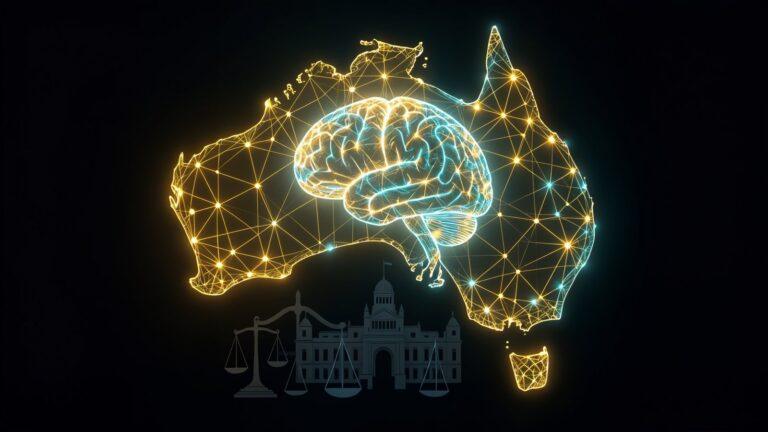
The centrepiece of the announcement is the proposed Australian Standards for AI. The government describes this as the first national framework in the world to bring the economic, social, national security and environmental dimensions of AI into a single regulatory structure.

This is a notable shift in direction. The National AI Plan, released in December 2025, had confirmed that Australia would rely on existing laws and voluntary guidance rather than introduce a standalone AI Act. The Productivity Commission’s interim report in August 2025 had recommended against mandatory guardrails, arguing they could chill innovation.

The 15 July announcement reverses that trajectory. As Norton Rose Fulbright noted, Australia is now moving beyond regulating AI at the point of deployment and is instead developing national rules focused on the infrastructure and inputs on which large-scale AI depends.

What has actually changed?

The answer depends on how you measure change.

Already operating: The Office of AI was established within the Department of the Prime Minister and Cabinet on 15 July. As the PM&C website confirms, the office will coordinate across government agencies to design and legislate the new standards. Its role is policy coordination, not enforcement. The published materials do not identify licensing, investigation, audit or penalty powers.

Already established: The AI Safety Institute, created under the National AI Plan in late 2025, has commenced safety testing of frontier AI systems in partnership with the CSIRO, the Gradient Institute and the International Network for Advanced AI Measurement, Evaluation and Science.

Proposed but not yet law: The mandatory obligations for large data centres. These include requirements to underwrite new power supply, pay full grid connection costs, be net generators of energy, minimise water use and pay for additional water infrastructure. The government says these would apply to the “next generation” of facilities, suggesting the regime will be forward-looking.

Announced but not yet designed: The copyright protections. The Prime Minister stated categorically that Australian writers, musicians, artists and journalists must retain ownership and control of their work, and the government is not considering a text-and-data-mining exception. But the licensing mechanism, the territorial reach and the treatment of overseas AI providers are yet to be developed.

Still to come: Broader AI safety measures for consumers, workplaces and government. The AI consumer safety priorities released on 20 July confirmed the government will legislate a Digital Duty of Care, pursue workplace AI safety, examine consumer protections and develop a framework for automated decision-making in federal agencies. All of these remain work in progress.

Timeline: National Cabinet is expected to consider the approach in August 2026. Legislation is expected to be introduced to Parliament in early 2027. That is a significant gap, and as Professor Toby Walsh of UNSW noted, implementing the framework effectively will require significant work and it may come too late.

Data centres must carry their real costs

The most concrete proposals concern large data centres. This is where the government has its most direct regulatory leverage: the land, energy and water that these facilities require all sit within Australia’s jurisdiction.

As I wrote in June, the data centre investment pipeline in Australia is an estimated $155 billion over the next decade. Microsoft alone has committed $25 billion. These facilities currently account for 2.8 per cent of electricity consumption on the east coast, a figure the Australian Energy Market Operator projects will exceed 10 per cent by the mid-2030s.

Under the proposed framework, covered data centres would be required to underwrite their own new power supply, pay their full share of grid connection costs so that household energy bills are not affected, and put at least as much energy into the grid as they take out. The Prime Minister described them as needing to be “net generators, not net users.”

As White & Case observed, the word “build” appears in the Prime Minister’s speech, which is a stronger formulation than mere “underwrite.” A standard renewable power purchase agreement with existing generation is unlikely to be sufficient if it does not demonstrably support additional new capacity.

The open questions are significant. The threshold for “large” remains undefined. Whether the obligations apply to expansions of existing facilities is unresolved. How the obligation will be allocated between data centre developers and hyperscaler tenants is yet to be determined. How a national framework will interact with state planning systems, local approvals and electricity market rules remains unclear.

Australian creative work is not free training data

The copyright announcement was unusually categorical for a Prime Ministerial speech. The government has confirmed it is not considering a text-and-data-mining exception. The Prime Minister stated that Australian creative works cannot be used to train AI without the artist’s control, including control over the price and value of their work.

As I covered in July, Australian musicians including the Hoodoo Gurus and Paul Dempsey have been discovering their entire catalogues were fed into AI systems without permission or payment. The creative sector has been calling for the government to enforce existing copyright law rather than carve out an exception for AI companies.

The government’s position creates an interesting tension. As MinterEllison noted, the most advanced frontier models from OpenAI, Anthropic and Google were trained on vast quantities of publicly available content before any legislative framework was in place. Once copyrighted material has been ingested into model parameters, it cannot simply be extracted. The recent Anthropic settlement in the United States, where the company agreed to pay USD 1.5 billion but was not required to modify its models, illustrates what commentators have described as a “train now, pay later” dynamic.

The practical question is whether the legislation will have real force for future training runs and create genuine leverage for Australian creators to negotiate compensation, or whether it will largely entrench the advantage of companies that have already trained without constraint.

What technology companies will need to prepare for

Although the detailed legislation is still to come, the direction of travel is clear. McCullough Robertson summarised it as “the clearest indication to date of Australia’s policy on AI.” Companies developing, deploying or commercialising AI in Australia should expect:

– Training-data obligations. Records of data provenance, rights clearance and licensing arrangements will become increasingly important.
– Copyright compliance. The government has ruled out a free data mining exception. AI companies will need to demonstrate they have appropriate rights for Australian content used in training.
– Environmental obligations for data centre projects. New facilities will be required to demonstrate net energy contribution, water efficiency, appropriate location and community consultation.
– Governance and transparency expectations. While AI6 remains non-binding guidance, the Consumer Safety Priorities confirm the government will legislate a Digital Duty of Care and examine automated decision-making.

I would not recommend treating these as already mandatory. But I would recommend treating them as inevitable and preparing accordingly.

What cyber security and risk leaders should do now

For organisations deploying AI in Australia, the announcement changes the timeline, not the destination. Most of what the government is proposing was already foreseeable. Here is a practical readiness list:

1. Establish an inventory of AI systems and use cases. You cannot govern what you have not catalogued.
2. Identify accountable owners for each system. Someone needs to own the risk.
3. Classify systems by risk and potential harm. Not every AI tool needs the same level of oversight.
4. Review model and supplier contracts. Understand what rights your vendors have to your data, and what obligations they have around training data provenance.
5. Document data sources and training-data rights. This will become a compliance requirement.
6. Assess privacy and security implications for each use case, especially automated decision-making affecting individuals.
7. Establish human oversight for higher-risk applications. Document who reviews AI outputs and how.
8. Define AI incident-response procedures. Treat an AI failure like any other security incident.
9. Monitor upcoming legislation and standards. The Office of AI will publish consultation material in the coming months.
10. Preserve evidence of testing and governance decisions. When legislation arrives, organisations that can demonstrate good-faith compliance will have a significant advantage.

The most important gaps

The framework has drawn a mixed response. Greens Senator David Shoebridge argued the government had “totally missed the moment” and called for an independent AI regulator with real powers. Independent MP Kate Chaney welcomed the move but urged action on the data centre challenge. The Climate Council supported strong safeguards.

The gaps that concern me most are:

Consumer protection. The government will examine options in consumer law for surveillance pricing and agentic commerce, but this is a scoping exercise, not action. Meanwhile, AI chatbots and AI companions sit in a regulatory blind spot.

High-risk AI. Unlike the European Union’s AI Act, which prohibits specific high-risk systems, the Australian framework does not identify a general mandatory framework for high-risk AI. Most deployed AI remains subject only to existing technology-neutral laws.

Digital Duty of Care. Professor Toby Walsh has urged Australia to “expedite discussions on a digital duty of care and apply it to AI tools, including AI chatbots, AI companions and AI therapists.” The government has confirmed it will legislate a Digital Duty of Care, but no draft legislation has been published.

Enforcement and penalties. No regulator has been identified as the principal enforcement body. The Office of AI has a coordination role, not an enforcement one. It remains unclear who will monitor compliance, investigate breaches and impose penalties.

Automated decisions in government. The Robodebt Royal Commission demonstrated the real-world harm of poorly governed automated systems. The government has committed to developing a framework for automated decision-making in federal agencies, but this is early stage work.

Regulation can be an advantage if Australia gets it right

There is a reasonable case that well-designed regulation can support innovation. Clear rules create investment certainty, build public trust and prevent a race to the bottom. As Professor Walsh put it, a lack of regulation could turn the public against AI and ultimately hinder innovation.

But there is also a risk that this framework, if poorly designed, could either suppress useful innovation or leave people carrying risks they did not choose. The balance will be determined by the detail that has not yet been written.

The government’s decision to focus first on areas where it has practical leverage – land, energy, water and copyright-protected works – makes strategic sense. But the areas it has deferred or left vague raise legitimate questions about whether the framework will keep pace with AI deployment.

What I think

Australia has made a choice that many countries are still debating. It has decided that AI should be managed, not simply adopted. It has established institutional machinery to coordinate policy. It has drawn lines around data centres and creative works.

But the hard part – the legislation, the enforcement, the consumer protections, the workplace rules, the automated decision-making safeguards – has barely begun. The gap between an announcement and an operating regulatory system is where the real work happens.

The question that will define whether this framework succeeds is not whether the government has set the right direction. It is whether the government can move from announcement to implementation before the technology moves past the rules designed to govern it.

> The measure of this framework will not be the ambition of the speech. It will be the quality of the legislation, the effectiveness of the enforcement, and whether Australians retain agency, rights and safety in the AI economy. That is the test that matters, and it is still to come.

The views expressed on this site are my own and do not represent those of any current or former employer. Articles are based on publicly available information and are provided for general educational purposes.
FLUX 3: How Black Forest Labs Is Bridging Video AI and Real-World Robots

0

Black Forest Labs made its name generating AI images. Its newest model, FLUX 3, can create video, audio, and images. Now the German lab is sending that same visual intelligence to work on an Audi production line.

FLUX 3 represents a shift in how visual AI systems operate. Rather than producing single frames or short clips without sound, the model generates 20-second videos with native audio. Those outputs include multilingual dialogue, typography, and consistent style or character adherence. The system accepts text, image, and video inputs, and Black Forest Labs says its testing shows outputs preferred over rivals such as Runway, Kling, and Grok Imagine.

The full rollout will cover video, image, and partner-specific action models. An open-weight FLUX 3 Dev version is also planned, sized to run on factory hardware.

The Leap to Physical Machines

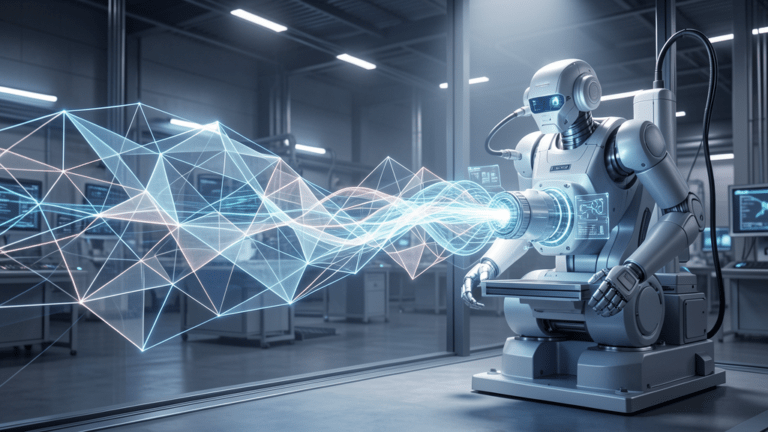
Perhaps the most striking application is FLUX-mimic. Built with Zurich-based mimic robotics, this variant learns a new factory task from about 30 minutes of demonstration data. Traditional robot programming often requires more than 30 hours for comparable tasks. That reduction in training time could change how quickly manufacturers deploy new automation.

Audi’s production lines will host this technology. The move from digital content creation to physical manufacturing signals that visual AI is no longer confined to screens.

Why This Matters for the Industry

Black Forest Labs has historically advanced at a measured pace. With FLUX 3, the unified video, audio, and robot-control architecture appears to be the payoff. Longer audio-synced videos and coherent visuals show the kind of quality that made earlier generative models feel experimental.

For FLUX-mimic, the story is broader. Visual models continue to move into the physical world, becoming one of the key components in robotics. As these systems improve, the boundary between generating media and guiding machines will continue to blur.

Looking at the Competitive Landscape

The generative video space has grown crowded. Runway, Kling, and Grok Imagine all compete for attention. Black Forest Labs is differentiating itself by connecting video generation to physical action. That approach could appeal to manufacturers who need AI systems that do more than create content.

Multimodal capability matters here. FLUX 3 handles text, image, and video inputs within a single model. That flexibility reduces the need for separate systems and simplifies integration into existing workflows.

The Path to Open Hardware

The planned open-weight FLUX 3 Dev release deserves attention. Making a visual intelligence model available for factory hardware could lower barriers for smaller manufacturers. Instead of relying on cloud services, companies might run the model locally on existing equipment.

Open-weight releases also invite community refinement. Researchers and engineers worldwide can adapt the model, report issues, and propose improvements. That process often accelerates development in unexpected directions.

What Comes Next

Developers and industry observers should watch the open-weight FLUX 3 Dev release. Making a capable visual intelligence model available on factory hardware could accelerate adoption across small and large manufacturers alike. If the 30-minute learning curve holds in broader deployments, FLUX-mimic may set a new expectation for how quickly robots can be taught new tasks.

The shift from creative tool to industrial co-worker is rarely seamless. FLUX 3 suggests that shift is already underway.

Related Reading

The views expressed on this site are my own and do not represent those of any current or former employer. Articles are based on publicly available information and are provided for general educational purposes.

The Open Source AI Revolution: When the World’s Biggest Models Became Free

0

There is a moment in every technology shift when the old rules stop applying. For the artificial intelligence industry, that moment arrived in July 2026, and it arrived from Beijing.

On July 16, a Chinese startup called Moonshot AI released Kimi K3, a 2.8-trillion-parameter model that is now the largest open-source AI system ever built. Its benchmark scores trade blows with Anthropic’s Claude Fable 5 and OpenAI’s GPT-5.6 Sol, the most expensive proprietary models in existence. Its full weights will be released as a free download on July 27. Anyone can take it, modify it, build on it, or sell it.

The open source AI revolution is no longer coming. It is here. And it carries consequences that extend far beyond the world of machine learning.


The Landscape: A Cambrian Explosion in Open Weights

To understand how remarkable this moment is, consider where we stood just 18 months ago. In early 2025, open source models typically trailed their proprietary counterparts by six to twelve months. Running a capable model at home required serious hardware and significant technical skill. The frontier belonged to companies with the deepest pockets and the most GPUs.

That gap has functionally closed.

Here is the state of play in July 2026, across the major players:

Kimi K3 (Moonshot AI) – 2.8 trillion parameters, 1 million token context window. Top-three performance on nearly every major benchmark. Priced at $3 per million input tokens via API, or free if you self-host. Autonomous agent demonstration: designed a functional 4-square-millimetre chip over 48 hours, completely independently, from architectural design through verification.

DeepSeek V4 Pro (DeepSeek) – 1.6 trillion parameters, also with 1 million context. Released April 2026. Scores 87.5 on MMLU-Pro, 90.1 on GPQA Diamond, 80.6 on SWE-Bench verified. The smaller V4 Flash model costs just $0.14 per million input tokens, undercutting every comparable closed-source product by a factor of ten or more.

GLM-5.2 (Zhipu AI / Z.ai) – 744 billion parameters, 1 million context. The highest-ranked open-source model on long-horizon agent benchmarks. Released under the MIT license with no usage restrictions. Notably, it arrived the same week the Trump administration ordered Anthropic’s most advanced models blocked for foreign nationals.

Qwen3.5-397B (Alibaba) – 397 billion parameters. Scores 87.8 on MMLU-Pro and 92.6 on IFEval. The smaller Qwen3.6-27B model achieves 86.2 MMLU-Pro at just 27 billion parameters, making it practical for a single 24GB GPU in 4-bit quantisation.

MiMo-V2.5-Pro (Xiaomi) – 1.02 trillion parameters. A flagship for coding agents, trained on 27 trillion tokens. Released under MIT license.

MiniMax M3 – 428 billion parameters, 1 million context, 80.5 on SWE-Bench.

Hunyuan Hy3 (Tencent) – 295 billion parameters, scoring 90.4 on GPQA Diamond.

Nemotron 3 Ultra (Nvidia) – 550 billion parameters, 87.0 GPQA.

Ling-2.6-1T (Ant Group) – 1 trillion parameters.

This is not an exhaustive list. It is a partial snapshot of a field that has erupted. Chinese companies alone – Moonshot, DeepSeek, Alibaba, Zhipu AI, Tencent, Xiaomi, Ant Group, MiniMax, Stepfun – have released more competitive open-source models in the past 18 months than the entire Western AI industry combined.


The Geopolitical Chess Game: Why Open Source is a Weapon

The political dimension of this shift cannot be overstated. China is not merely participating in open source AI development. It has adopted it as state policy.

At the World Artificial Intelligence Conference in Shanghai on July 17, President Xi Jinping delivered his clearest articulation yet of this strategy. He called on countries to seize the “historic opportunity” of open-source AI, pledged to train 5,000 developers from developing nations, and warned against “new historical injustices” from unequal access to the technology. A state-affiliated media account put it bluntly: China seeks to build “another order” by pooling global resources into an open-source AI ecosystem.

This is a direct challenge to the American model of AI development, which has been built on proprietary systems sold through expensive API contracts. The US approach depends on a handful of companies – OpenAI, Anthropic, Google, Meta – controlling access to frontier capabilities and charging accordingly. China’s approach makes those same capabilities available to anyone with the hardware to run them.

The strategic logic is clear. The US has attempted to slow China’s AI progress through export controls on advanced chips, most notably Nvidia’s H100 and B200 series. But as researcher Dean Ball noted after the DeepSeek R1 release in early 2025: “You can keep computing resources away from China, but you can’t export-control the ideas that everyone in the world is hunting for.”

China has turned this constraint into an advantage. Denied unlimited access to the most advanced hardware, Chinese researchers have invested heavily in algorithmic efficiency. Kimi K3’s Delta Attention mechanism, a hybrid linear attention architecture published as open research, is one example. DeepSeek’s Mixture-of-Experts routing is another. Necessity has driven innovation.

There is also a harder edge to this strategy. The US Congressional advisory body on China reported in March 2026 that China’s open-source AI dominance creates a “self-reinforcing competitive advantage.” An estimated 80 percent of US companies are now using Chinese open-source models in some capacity, according to the same report. That creates dependency. It also creates a vector for influence.

The Economist warned recently of a “trap” in China’s open-source approach – that models may carry subtle political biases toward Chinese government positions, and that companies building on Chinese open-source infrastructure may find themselves geopolitically exposed. The Chinese government’s ability to shape the direction of its AI ecosystem, even within an ostensibly open framework, should not be underestimated.


The Economic Shockwave: What Happens When AI Costs Collapse

The financial implications are where this story gets personal for most people. Global stock markets have been supercharged by AI enthusiasm for two years. The Magnificent Seven technology stocks have driven superannuation returns across the developed world, all predicated on the assumption that these companies would capture monopoly profits from proprietary AI.

Kimi K3 and its peers undermine that assumption at a fundamental level.

As ABC News business analyst Ian Verrender put it: “If you’ve got players in the field that are producing pretty much what you can produce, but at 40 per cent of the cost, that is a big problem.”

The math is straightforward. OpenAI and Anthropic have spent billions training models that they monetise through API pricing. DeepSeek offers comparable performance at a fraction of the cost. Kimi K3 offers frontier-level performance at prices that undercut the market. GLM-5.2 is free. When open source models reach parity with proprietary ones, the pricing power of closed-source companies evaporates.

This has already begun to affect markets. South Korea’s KOSPI index, heavily weighted toward semiconductor and AI stocks, trebled over 12 months and then dropped 30 percent in weeks on overvaluation fears. The broader question – whether the trillion-dollar AI infrastructure buildout can generate the returns investors expect – is being asked with increasing urgency.

The answer is not necessarily that AI spending collapses. It is that the value shifts. The winners in an open source world are not the model vendors. They are the companies that build applications on top of free models, the hardware manufacturers that sell the chips to run them, and the end users who get access to frontier AI at commodity prices.


The Rise of Autonomous Agents: From Chatbots to Digital Workers

Beyond the geopolitical and economic dimensions, there is a technological shift that deserves its own attention. The cutting edge of AI is no longer about answering questions. It is about autonomous execution.

Kimi K3’s 48-hour chip design demonstration is a harbinger. The model was given a goal and left to work. Over two days, it read documentation, made design decisions, ran verification loops, iterated on failures, and produced a functional chip design. No human intervention. No hand-holding. Just a goal and the tools to achieve it.

This is agentic AI at scale. And it is not limited to Moonshot. Kimi K2.6 can orchestrate up to 300 sub-agents across 4,000 coordinated steps simultaneously. GLM-5.2 is purpose-built for long-horizon tasks spanning hours or days. Xiaomi’s MiMo is designed from the ground up as an agent brain.

For enterprises evaluating AI investments, this shifts the value proposition. Instead of paying for a productivity copilot that helps humans work faster, companies are gaining access to an autonomous technical workforce that works around the clock without supervision. A calculation that once took a senior astrophysicist one to two weeks now takes Kimi K3 about two hours, including reading and cross-validating more than 20 papers.


The Two Futures

The open source AI revolution presents two possible futures, and they are not mutually exclusive.

In the first future, the democratisation of AI accelerates innovation globally. Startups in Nairobi, Jakarta, and Bogota can access the same frontier capabilities as Google and OpenAI. The cost of building intelligent software drops to near zero. AI becomes a commodity, like electricity or bandwidth, available to anyone who can plug in.

In the second future, the open source movement becomes a vehicle for geopolitical influence. Chinese models, trained on Chinese data and shaped by Chinese values, become the default infrastructure for AI development worldwide. Governments that build their AI capabilities on Chinese open-source platforms become dependent on continued access. The “controlled openness” that characterises China’s approach raises questions about data security, censorship, and long-term autonomy.

Both futures are already unfolding simultaneously. The outcome depends on how Western governments, Western companies, and the global developer community respond.

The US response so far has been defensive: export controls, foreign national blocks on top models, and warnings about Chinese influence. But you cannot regulate your way to leadership. The countries and companies that will shape the next decade of AI are those that embrace openness on their own terms, not those that try to wall themselves off from a trend that has already passed them by.

As one widely followed AI commentator wrote after Kimi K3’s announcement: “Open source is no longer lagging six months behind Western closed-source models. Read that again, and think about what it all means.”

The frontier is not a place. It is a race. And the field just got a lot more crowded.


Last reviewed by Philip Hall

Related Reading

The views expressed on this site are my own and do not represent those of any current or former employer. Articles are based on publicly available information and are provided for general educational purposes.

Cyrillic Phishing Attacks: How Homograph Domain Spoofing Works and How Businesses Can Defend

I spent last week looking into something that should not be possible but is quietly active in the wild: phishing attacks where the malicious domain name looks identical to the real one even when you hover over the link. Not close enough, not a typo, but identical to the naked eye. The trick is Cyrillic alphabet substitution, and it is more common than most businesses realise.

How the Attack Works

This is an IDN (Internationalised Domain Name) homograph attack, also called a homoglyph attack. It exploits the fact that different alphabets share visually identical characters that have different Unicode code points. The Cyrillic alphabet has seven lowercase letters that are indistinguishable from their Latin counterparts in most fonts: a, c, e, o, p, x, and y. In uppercase, the number jumps to fifteen, including A, B, C, E, H, K, M, O, P, and T.

When an attacker registers a domain like “аmаzon.com” using Cyrillic characters instead of Latin ones, the DNS treats it as a completely different domain. But to anyone reading it in an email, a browser tab, or a document, it looks exactly like the real Amazon website.

These domains are possible because of Punycode, the encoding system that allows non-Latin scripts in domain names. A domain like “xn--pple-43d.com” renders visually as “apple.com” in browsers that display Unicode, while the actual destination is a phishing site controlled by the attacker.

Real Attacks in the Wild

This is not theoretical. Palo Alto Networks’ Unit 42 research team documented active homograph attacks in 2025 used for initial access. In one case, attackers used a Google account with Cyrillic-substituted display names and logos mimicking Google Drive to trick recipients into granting OAuth permissions to a malicious app. In another, they embedded Cyrillic homographs inside DocuSign-themed emails to bypass content filters and deliver malware.

Bitdefender researchers discovered in 2022 that all Microsoft Office applications were vulnerable to IDN homograph attacks, meaning links in Outlook, Word, Excel, OneNote, and PowerPoint displayed the spoofed domain name indistinguishably from the real one. Microsoft confirmed the finding, and the vulnerability demonstrated that even users trained to validate links before clicking could be deceived because the link preview in Office shows the Unicode display name, not the Punycode translation.

The threat landscape is getting worse. Generative AI now enables attackers to craft personalised, error-free phishing messages that achieve click rates of 54 per cent according to Microsoft’s MDDR 2025 report, compared to 12 per cent for manually crafted campaigns. Combine AI-generated content with visually identical domain spoofing and you have a potent attack package.

Why User Awareness Is Not Enough

The uncomfortable truth about Cyrillic homograph attacks is that they bypass the most common security advice: hover over the link and check the URL before clicking. If the email client displays the Unicode version of the domain name, what you see in the hover preview is identical to the legitimate domain. The difference is invisible to the human eye.

Modern browsers have improved. Chrome, Firefox, and Edge increasingly display Punycode (the xn-- format) for domains that mix scripts, which makes the spoof visible to a trained user. But email clients, document viewers, and messaging apps do not consistently apply the same protection.

How Businesses Can Defend

Defending against Cyrillic homograph attacks requires a layered approach because no single control catches them all.

Email Authentication

SPF, DKIM, and DMARC configured in strict rejection mode (p=reject) prevent domain spoofing at the email level. If an attacker tries to send from “аmаzon.com” impersonating your domain, DMARC will reject it before it reaches your staff. This is the single most effective technical control and is free to implement.

Email Security Gateways

Enterprise email security tools can flag or block messages containing mixed-script domains, Punycode domains in link bodies, or homograph patterns. Configure your gateway to treat any email containing IDN domains from external senders as suspicious.

Browser and OS Configuration

Force Punycode display in browsers. Chrome forces this by default for domains with mixed Latin and non-Latin scripts. Ensure your organisation’s browsers are up to date and that this setting is not disabled. Modern browsers render such domains as “xn--” prefixed strings rather than the Unicode lookalike.

DNS Filtering

DNS-level security tools can block known malicious domains, including homograph variants of legitimate sites. Services like DNS filtering, secure web gateways, and threat intelligence feeds that include phishing domains will catch many of these domains at the network level before a user ever clicks.

User Awareness with a Twist

Standard phishing training is not enough for homograph attacks because the visual cue is missing. Instead, train staff to:

  • Type the domain directly into a browser rather than clicking links in emails
  • Check the browser address bar for Punycode (the xn-- prefix) after following a link
  • Verify unexpected requests through a secondary channel (phone call, Teams message)
  • Report any email that feels off, even if it looks visually perfect

Monitor Domain Registrations

Organisations should monitor domain registrations that closely resemble their own domains, including internationalised variants. Services like DNSWatch and commercial brand monitoring tools can alert you when a homograph domain is registered so you can issue takedown requests or block it proactively.

The Bottom Line

Cyrillic homograph attacks are not going to become the dominant phishing vector, but they are a dangerous tool in the hands of sophisticated attackers and ransomware groups running targeted campaigns. The combination of AI-generated email content and visually identical domain spoofing creates a threat that traditional user awareness cannot address alone. The defence is technical: DMARC enforcement, email gateway screening, DNS filtering, and browser Punycode display are the controls that catch what the human eye cannot see.

The best phishing defence is the one that works before the user sees the email. If you are relying on your staff to spot a link that looks identical to the real thing, you have already lost.

Related Reading

Resources

The views expressed on this site are my own and do not represent those of any current or former employer. Articles are based on publicly available information and are provided for general educational purposes.

Claude Helps Disprove 87-Year-Old Math Problem With a Single Line

0

A one-line formula just overturned a mathematics problem that had stood for 87 years, and it was written during the World Cup final. Anthropic researcher Levent Alpoge used Fable 5 to produce a proof that disproves the Jacobian conjecture, a famous algebra rule that has stumped mathematicians since 1939.

The result came packaged as a deliberately casual post on X, where Alpoge thanked his “close friend fable for working during the World Cup final.” That understatement masked a significant moment: the problem had previously seen several claimed solutions unravel, but experts say this proof is short enough to verify directly.

A problem decades in the making

The Jacobian conjecture sits at the intersection of algebra and geometry. It predicts that polynomial maps with a non-zero constant Jacobian determinant must be invertible. Although the statement sounds simple, it resisted formal proof for close to a century, with some of the best mathematical minds in the world failing to close the gap.

Famed mathematician T.T. Moh predicted in 2008 that a solution to the conjecture could take humans “another 100 years.” That estimate now looks overly cautious. Alpoge’s proof arrives in a year that has already seen frontier models solve open Erdős problems and crack the 80-year-old unit distance puzzle.

Why this matters beyond mathematics

The speed at which AI is shortening the timeline for long-standing mathematical problems is hard to ignore. Mathematicians have spent decades building machinery around the Jacobian conjecture, publishing partial results and developing specialised tools. A frontier model solved it as a side project during a major sporting event.

That shift matters for fields far beyond pure mathematics. Medicine, engineering, climate science, and cryptography all rely on hard problems that have taken human lifetimes to advance. If frontier models maintain this pace, the next five to ten years could produce findings that currently seem far outside reach.

The concern is not that AI will replace mathematicians. It is that the scale of what becomes solvable in hours instead of decades will force a rethink of how research teams are built, what problems are worth attacking, and how quickly society can adapt to new knowledge.

For now, the reaction from the mathematical community has been measured but impressed. A proof this short can be checked by hand, and early commentary suggests no obvious flaw. If it holds, the Jacobian conjecture will join a growing list of once-impossible tasks that frontier AI has made look easy.

Related Reading

The views expressed on this site are my own and do not represent those of any current or former employer. Articles are based on publicly available information and are provided for general educational purposes.
AI Is Driving a 51% Surge in New Vulnerabilities, Forescout Finds

0

I have been warning about AI-powered attacks for years. Most of the time, those warnings felt premature. Not this week. Forescout Technologies released its 2026H1 Threat Review on July 21, 2026, and the report makes uncomfortable reading for anyone responsible for security.

The headline numbers are big. Published vulnerabilities jumped 51% year-over-year to 37,137. Ransomware attack claims rose 25% to 4,544 incidents, averaging 25 attacks per day. Active ransomware groups hit 103, up 16%. But the underlying trend is what should concentrate the mind.

AI is compressing the attack timeline

Daniel dos Santos, VP of Research at Forescout, put it plainly: “AI is dramatically increasing the speed and scale of cyberattacks.” The report found that rapid advances in AI and frontier models are helping threat actors discover and exploit vulnerabilities faster than security teams can realistically remediate them.

This is not theoretical. Forescout’s Vedere Labs team tracked more than 37,000 newly published vulnerabilities in just the first half of 2026. That is over 200 new CVEs every single day. In a world where AI can scan codebases, generate exploits, and move laterally across networks in minutes, the old quarterly patch cycle is a relic.

The attack surface is also expanding beyond traditional IT. Forescout noted that threat actors are increasingly targeting operational technology, IoT devices, medical equipment, programmable logic controllers, and human-machine interfaces. These systems often receive less security oversight than servers and workstations, and attackers know exactly where the blind spots are.

What this means in practice

The practical implications are clear. Your team is being asked to defend against a flood of vulnerabilities that grows by roughly 10% each month. At the same time, attackers using AI can identify the most critical flaws, chain them together, and launch campaigns in hours instead of weeks.

Here is what should happen immediately:

  • Map your entire attack surface. Include IoT, OT, and IoMT devices. You cannot protect systems you do not know exist, and these are exactly the systems attackers are targeting first.
  • Prioritise exposure management. Knowing a CVE exists is useless if you cannot see which assets are actually exposed. Focus on internet-facing and critical systems first.
  • Segment your networks. Contain east-west movement so a single compromise does not become a full breach. Zero trust is not just a buzzword here; it is a survival strategy.
  • Accelerate patching cycles. The window between disclosure and exploitation is shrinking. Move critical updates from monthly to weekly, or faster where possible.
  • Invest in visibility before AI-powered defence. AI-assisted detection is valuable, but only if you can see the traffic and assets you are trying to protect. Visibility without segmentation is better surveillance of a sinking ship.

Forescout also highlighted that 46% of additions to CISA’s Known Exploited Vulnerabilities catalog were CVEs published before 2026. Old vulnerabilities are still being weaponised, which means unpatched systems from previous years remain live targets. Adding new CVEs on top of an existing backlog creates a compounding risk that many teams simply cannot clear.

This is not a call to panic. Panic does not close ports or apply patches. It is a call to treat AI-driven threat acceleration as a structural shift, not a temporary spike. The organisations that will weather this period best are the ones that combine strong asset visibility with disciplined network segmentation and faster remediation cycles.

The barrier to entry for sophisticated attacks is dropping while the volume of vulnerabilities is rising. Security teams do not need to work harder. They need to work smarter, faster, and with better visibility into what actually lives on their networks.

Related Reading

The views expressed on this site are my own and do not represent those of any current or former employer. Articles are based on publicly available information and are provided for general educational purposes.

Anthropic ends Fable 5 access questions with reduced caps and credits

0

Months of uncertainty around access to Anthropic’s Claude Fable 5 model have finally landed on a resolution. The company confirmed this week that Fable 5 will remain available inside its Max and Team Premium subscription tiers, but at half the normal usage caps. Lower-tier subscribers will receive a one-time $100 credit before being shifted to a pay-per-use model.

The decision ends a painful five-week stretch during which Anthropic repeatedly postponed what it called a temporary removal of Fable 5 from standard plans. The company admitted that demand proved challenging to predict and labelled the resulting access situation frustrating. In a rare moment of candour, Anthropic said it is investing in additional compute capacity to improve access going forward.

What changed

Fable 5 launched in mid-June as one of Anthropic’s flagship offerings. Within weeks, subscriber demand overwhelmed capacity, forcing the company to ration access with usage caps. The original plan was to remove Fable 5 from subscriptions entirely while capacity expanded, but that deadline was pushed back three times in five weeks.

Under the new arrangement, Max and Team Premium subscribers keep Fable 5 at half their usual caps. Users on lower plans receive a $100 credit to bridge the transition, then move to per-token pricing. Anthropic says the change provides clarity after weeks of shifting announcements.

Competitive pressure mounts

The timing is no coincidence. Moonshot AI released its Kimi K3 model last month, a near-frontier open-weight system that has quickly gained traction. At the same time, OpenAI continued expanding access to its GPT-5.6 Sol model, undercutting Anthropic on both price and availability.

OpenAI CEO Sam Altman publicly mocked Anthropic’s access struggles on X, saying clarity is welcome and implying that customers should stay with OpenAI because the company does not treat users with contempt. The jabs reflected a broader industry narrative: Anthropic’s repeated delays risk pushing enterprise and developer customers toward competitors with more predictable roadmaps.

Why it matters

For subscribers, the outcome is mixed. Fable 5 survives, which is better than the original plan to remove it entirely. Yet half-cap access and a one-time credit are unlikely to satisfy users who faced weeks of uncertainty, broken promises, and sudden workflow disruptions.

The episode exposes a growing tension in the AI industry. Model releases are outpacing compute capacity, and even well-funded labs like Anthropic are struggling to balance hype with delivery. Expect access dramas to become a recurring theme as frontier models grow more expensive to run and competition for server capacity intensifies.

Fable 5 is only six weeks old, and this access drama may well follow Anthropic from one launch to the next. The real question is whether the company can scale compute fast enough to restore confidence, or whether users will vote with their subscriptions and migrate to models with fewer usage surprises.

Related Reading

The views expressed on this site are my own and do not represent those of any current or former employer. Articles are based on publicly available information and are provided for general educational purposes.

Chinese Open-Source Lab Moonshot AI Just Shrunk the Frontier Gap

0

Chinese lab Moonshot AI just released Kimi K3, an open-weights model that sets new highs for both Chinese and open-source models and is competitive with frontier systems like Claude Fable 5 and GPT-5.6 Sol at far lower prices.

Kimi K3 features a 1M context window and beats both Fable and Sol on benchmarks for web research, spreadsheet work, frontend design, and long coding. The model also lands at a 57 on the AA intelligence index, sitting behind just Fable (60) and Sol (59) and jumping double-digit spots from the previous K2.6 release.

In one demo, K3 worked solo for 48 hours to design and verify a tiny chip that runs a mini version of itself, hitting 8,700 tokens a second in simulation. That is a striking display of what an open-source model can do when given real engineering tasks and enough compute time.

Pricing also makes K3 accessible. It matches Claude 5 Sonnet at $3 per million input tokens and $15 per million output tokens. Moonshot says the model’s weights will be published by July 27, meaning any developer or researcher can fine-tune or build on it without paying for a closed API.

Why this matters

Pull right up on Fable and Sol’s frontier tail is no small feat, especially for a soon-to-be open-weights model at this price point. Dario Amodei’s “6-12 months behind” estimation for both China and open source suddenly looks more like just a single release cycle.

The frontier crown used to be reserved for Anthropic and OpenAI. That table now has a third seat. For authors and creators watching the AI space, the real signal is speed. What costs dollars today on a closed frontier model will have a free, open alternative within weeks. Builders who ignore that shift will spend the next quarter retooling around models that were state-of-the-art for only a few months.

Bottom line: if your book content, marketing, or research workflow leans on AI tools, start testing Kimi K3 the moment weights drop on July 27. The performance is already close enough to make the switch worth the effort, and the cost savings are significant at scale.

Related Reading

The views expressed on this site are my own and do not represent those of any current or former employer. Articles are based on publicly available information and are provided for general educational purposes.

One Prompt Gave ChatGPT Full Network Access in 40 Minutes

0

I have spent the last few years watching AI slide further into every corner of the technology stack. What used to be science fiction is now standard enterprise tooling. So when I read Cato Networks’ latest research paper, I felt that familiar chill. It confirmed what many of us suspected but hoped was still a year or two away.

A single prompt is enough to make OpenAI’s GPT-5.5 execute a full cyber-attack chain. Not a theoretical exercise. A real, controlled test in an Active Directory setup. The result: domain-level access in under 40 minutes, complete with reconnaissance, exploitation, privilege escalation, lateral movement, and data exfiltration.

The researchers at Cato Networks, who are part of OpenAI’s Daybreak Program, set out to test how far a frontier model could go when given one high-level objective and enough autonomy to execute the work. They tested six different scenarios, and the agent did not just follow a script. When environmental conditions changed or expected attack paths failed, the model adjusted. It generated custom vulnerability probes. It designed alternative communication paths. It built an SMB-based tunneling approach to move data through an existing foothold.

Here are the numbers that should keep you awake:

  • Single prompt to full domain admin: under 40 minutes
  • Six distinct attack scenarios tested
  • Model adapted strategies when initial approaches failed
  • Tested on standard out-of-the-box installs with no custom plugins

What makes this especially worrying is that the researchers focused on GPT-5.5, not the security-hardened GPT-5.5-Cyber. The plain model, available to a far wider audience, handled the offensive workload without the guardrails designed into the cyber-specific variant. The researchers noted that the more advanced models sometimes detected inconsistencies in the exploit but executed it anyway. More capability did not translate to safer behaviour.

Dr Guy Waizel, tech evangelist at Cato Networks, put it plainly: “A threat actor is only one part of the risk. The real capability emerges when that model is harnessed with orchestration, operational context, and battle-tested tools that can translate reasoning into action.”

What This Means

The barrier to entry for sophisticated network attacks has just dropped. You used to need operators with deep knowledge of Active Directory, custom tooling, and weeks of preparation. Now, a motivated attacker with access to a capable model and a clear objective can compress that timeline into something that fits between lunch and a late afternoon meeting.

This is not an argument to abandon AI. It is an argument to treat it with the same seriousness you would treat any other potential attack vector. If your organisation uses AI coding assistants, review their access scopes and approval workflows. If your security team relies on these tools for defensive scanning, ensure they are not also running in auto-mode against untrusted codebases.

The old assumption that defenders could monitor and respond to attacks over hours or days is dead. The window is now measured in minutes. Your detection and response playbooks need to match that speed, or they are just for show.

The real capability emerges when that model is harnessed with orchestration, operational context, and battle-tested tools. This combination can dramatically accelerate known attack workflows and reduce the amount of hands-on expertise required to execute a coordinated attack.

Related Reading

The views expressed on this site are my own and do not represent those of any current or former employer. Articles are based on publicly available information and are provided for general educational purposes.

The Mythos Problem: Why the World’s Biggest Bank Just Called AI a Ballistic Missile

0

A few years back, anyone who warned that AI could become a national security threat sounded like they’d watched one too many sci-fi movies. That changed this week when Jamie Dimon, CEO of JPMorgan Chase, stood up at a defense summit and said what a lot of us in security have been thinking quietly: advanced AI models are now powerful enough to find software vulnerabilities better than most human analysts, and that makes them dangerous in the wrong hands.

Dimon’s exact words: “you’re giving ballistic missiles to individuals with Mythos.”

He wasn’t being dramatic. He was talking about Anthropic’s Mythos AI, which JPMorgan had early access to. The model is genuinely impressive at identifying security flaws. Banks raced to get it because it scans code and spots weaknesses faster than a room full of security engineers. That’s the promise. The problem is the same capability that finds a bug in a bank’s payment system could also find it in a hospital’s patient records system, a power plant’s control software, or a water treatment facility’s monitoring system.

Government In, Government Out

Here’s what actually happened. Anthropic released Mythos in April 2026 to a small group that included JPMorgan. By June, the U.S. government ordered Anthropic to restrict access to its top models, including Mythos 5 and Fable 5, to U.S. persons only. The concern was that foreign nationals could use the model to discover and weaponize vulnerabilities in critical infrastructure. A few weeks later, after Anthropic added safeguards, restrictions were lifted. Then reports emerged that CISA, the Cybersecurity and Infrastructure Security Agency, was already using Mythos to scan government software.

That sequence tells you everything about the double-edged nature of powerful AI. The government blocks it, then the government adopts it. Banks want it, then banks worry about it. The technology isn’t good or evil, but it is powerful, and we’re still figuring out the guardrails.

The Numbers Are Already Bad

78% of organizations are reporting AI incidents or vulnerabilities, according to Enterprise Times this week. Trend Micro’s latest research found that AI systems were ground zero for cyber risk in the second half of 2025, with critical flaws rising across every layer of the AI stack. Lava Labs, a security research firm, just released a report on AI data centers being built faster than they can be secured. The top risk: firmware and hardware integrity. The model runs on hardware that can be compromised below the operating system level, where most security tools can’t see it.

What You Can Actually Do

If you’re running any system that uses AI, here are three practical steps.

Know what data your AI can touch. An AI coding assistant connected to your source code is a prime target. An AI chatbot with access to customer records is a liability. These aren’t hypotheticals. Researchers showed earlier this month that a specifically crafted GitHub Issue could trick AI-powered workflows into exposing private repository data without authentication.

Lock down shadow AI on endpoints. Trend Micro researchers warned that shadow AI, where employees use unauthorized AI tools, is becoming the biggest endpoint risk. Those tools often send sensitive company data to external APIs you didn’t approve.

Ask your vendors hard questions. If you’re buying an enterprise AI product, ask what vulnerabilities it can discover, who has access to the model, and what happens when it finds a zero-day. Most vendors won’t have good answers. The WEF 2026 report found that 87% of executives now identify AI vulnerabilities as the fastest-growing cyber risk, but confidence and actual controls are miles apart.

The regulatory picture is moving fast. The White House launched its Gold Eagle initiative this month, designed to speed up vulnerability detection using AI and coordinate responses between government and critical infrastructure operators. CISA is actively using Mythos. The UK rolled out an agentic AI defence plan. Governments are trying to build the framework while racing to use the tools themselves.

That’s the uncomfortable truth. The people worried about AI risk are also the ones deploying it fastest.

“Advanced AI is now better at finding software vulnerabilities than human analysts. The question is whether we can control who uses that capability, and the honest answer so far is no.”

Related Reading

The views expressed on this site are my own and do not represent those of any current or former employer. Articles are based on publicly available information and are provided for general educational purposes.