

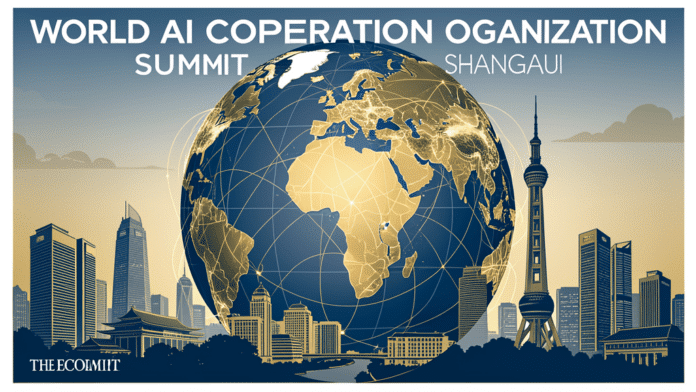

On 16 July 2026, twenty-nine countries signed an agreement in Shanghai to establish the World Artificial Intelligence Cooperation Organization (WAICO), a new intergovernmental body headquartered in China. The founding members include Russia, Belarus, Serbia, Cuba, Brazil and Venezuela, alongside 10 African and 12 Asian nations.
Notably absent: the United States, any Western European nation, or any of the traditional G7 powers.
The signing ceremony took place on the eve of the annual World Artificial Intelligence Conference (WAIC), where President Xi Jinping personally appeared to open the event for the first time. UN Secretary-General Antonio Guterres attended. It was a carefully choreographed week of diplomatic theatre, and the message was unmistakable: China is building its own table for AI governance, and it is inviting the Global South to sit down.
But is WAICO a genuine attempt to close the AI access gap, or a geopolitical power play dressed in multilateral clothing? Let’s look at both sides.
The Case for WAICO: A Voice for the Left Behind
There is a real and growing divide in global AI access. The United States and China dominate frontier AI development, while most developing nations have little say in the rules that will govern the technology shaping their future. WAICO’s advocates argue this body fills a genuine vacuum.
China frames its offer as open-source cooperation. In his WAIC speech, Xi Jinping called open-source AI a “historic opportunity” and pledged to help developing nations build AI capabilities, warning against the emergence of “new historical injustices” from unequal access. China’s Moonshot AI unveiled the Kimi K3, described as the world’s largest open AI model, the same week.
The price point is compelling. Chinese AI models are significantly cheaper than their US counterparts. Companies like Siemens have adopted Chinese open-source models, attracted by performance, lower cost and customisation. For developing nations with limited budgets, this is not ideology, it is economics.
It offers a seat at the table. An Asian diplomat told Reuters: “China has been making inroads with Southeast Asian countries in terms of AI capacity-building. It portrays itself as speaking up for developing countries who are being left behind in the AI race.” WAICO promises AI training, cooperation centres with BRICS, ASEAN, Latin American and African Union countries, and 5,000 research and training opportunities over five years.
From this perspective, WAICO addresses a real problem. The current AI governance architecture, the EU AI Act, the G7 process, the US-led “Pax Silica” initiative, was built by wealthy nations for wealthy nations. WAICO offers an alternative that at least pays lip service to equity.
The Case Against: A Trojan Horse for Chinese Standards
The sceptical view is that WAICO is less about cooperation and more about entrenching Beijing’s technological standards as the global default, particularly in markets where Western alternatives are politically or economically inaccessible.
The membership list tells a story. Russia, Belarus, Cuba, Venezuela: these are not neutral observers. They are nations with strategic alignment to Beijing and, in several cases, active opposition to US-led international frameworks. Ten African nations signed, but many were invited as part of China’s broader diplomatic push into the continent, where Beijing has invested heavily in infrastructure and debt diplomacy.
Open source has limits. Xi’s speech promoting open-source cooperation sits awkwardly alongside Reuters reporting that Beijing is considering restrictions on overseas access to some of China’s leading AI models. The tension between promoting openness and tightening national security controls is not unique to China; the US has its own export controls. But it undercuts the “public good” framing.
It weakens Western AI governance efforts. By creating a parallel structure, WAICO gives nations an alternative to the EU AI Act or US-led frameworks. Critics argue this fragments global AI governance at exactly the moment when coordinated oversight of frontier AI capabilities is most needed. A unified approach to AI safety, particularly around catastrophic risk, becomes harder when rival governance systems compete for signatories.
A France24 analysis noted that Xi “opposed overstretching the national security concept in the field of AI or placing one country’s security over that of others,” a clear reference to US chip export controls. WAICO is as much a rebuke of American technology policy as it is a proposal for cooperation.
The Missing Middle
Neither reading of WAICO is complete, and the truth sits somewhere in the contested space between them.
On the one hand, the Global South genuinely needs affordable AI access. China’s open-source models are real, they are competitive, and they are being used by companies and governments worldwide. A governance body that represents developing nations is not inherently a bad thing, even if it is initiated by Beijing.
On the other hand, WAICO’s launch alongside Xi’s strongest-ever critique of US AI policy makes it impossible to separate from the broader US-China technological contest. This is not just about AI governance; it is about who writes the rules that will govern the digital economy of the twenty-first century.
What is unresolved: WAICO’s stated principles include “respect for sovereignty” and “openness,” but the body has no enforcement mechanism, no independent oversight, and no clear path for Western nations to join without endorsing China’s broader geopolitical positioning. About 40 countries were invited to consultations; only 29 signed. More may follow by the 31 July deadline, but the absence of India, Japan, South Korea and most of Europe is notable.
For the technology sector, particularly fintech, banking and AI-enabled services, WAICO signals a multi-polar future where digital standards diverge between Western and Chinese-aligned markets. Companies operating globally will need to navigate two sets of AI rules, two certification regimes, and two technology ecosystems.
That is not a minor administrative inconvenience. It is the shape of things to come.
Related Reading
- China’s AI Debate: Is the Public Consensus Real or Manufactured?
- DeepMind CEO Demis Hassabis: We Are at the ‘Foothills of the Singularity’ – and He Has a Plan
- The Ex-OpenAI Researcher Who Walked Away from $2 Million: What Daniel Kokotajlo Actually Said About AI Risk
“AI development should not be a solo performance by a single country, but a symphony of international cooperation.”
Xi Jinping, World AI Conference, Shanghai, 17 July 2026
The views expressed on this site are my own and do not represent those of any current or former employer. Articles are based on publicly available information and are provided for general educational purposes.
