

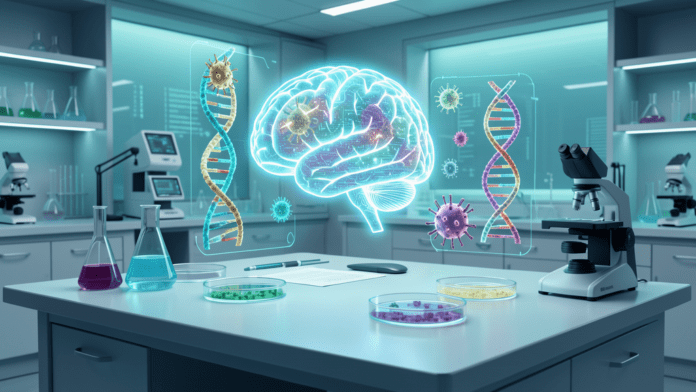

Scientists at Stanford and the Arc Institute have reached a milestone that reads like science fiction: they used artificial intelligence to design 16 viruses that do not exist in nature, built them in a laboratory, and confirmed they work. The breakthrough, published in the journal Science, marks the first time a language model has generated complete, functional genomes from scratch.
How the AI designed new viruses
The research team trained two models, Evo 1 and Evo 2, on millions of genomes from across the tree of life. They then asked the models to write new versions of Phi X174, a well-studied virus that infects only E. coli. Of 285 phages synthesised and tested, 16 were viable. Some replicated faster than the original, and a few were different enough to count as entirely new species.
A cocktail of AI-made viruses successfully wiped out E. coli that had grown resistant to the natural Phi X174. That proof of concept points toward future therapies for antibiotic-resistant infections, a growing threat in hospitals worldwide. The approach could eventually lead to personalised phage treatments that adapt to specific bacterial strains faster than traditional drug development allows.
The safety guardrails
The researchers built in a critical safeguard: the models were never trained on viruses that infect humans, animals, or plants. As a result, the system cannot generate anything that threatens people. That boundary kept the experiment ethical and contained, but it also highlights the double-edged nature of the technology. The same tool that fights superbugs could, with different training data, design harmful pathogens.
Evo 2 is open source, which means the research community can build on it, audit it, and improve it. That openness accelerates scientific progress, yet it also means bad actors could access the same capabilities. Regulators and research labs are now grappling with how to balance transparency with safety.
Why this matters beyond the lab
The AI that designs viruses to beat drug-resistant infections could, if trained differently, also help build dangerous pathogens. The scientific community now faces mounting pressure to establish guardrails and testing frameworks for biosafety before the technology outpaces the rules. Industry groups and government agencies are already calling for clearer oversight of generative biology tools.
Expect more breakthroughs in AI-designed biology in the coming months. The question is whether policy and safety research can keep pace with the science. This research pushes the boundary of what AI can achieve in the life sciences, and it demands a responsible response from the entire tech and science ecosystem.
For now, the work stands as a proof of concept. The researchers have shown that AI can move beyond predicting molecular structures to writing entirely new ones that function in the real world. That leap from prediction to creation is what makes this era of biology so extraordinary, and so worthy of close attention.
The intersection of artificial intelligence and synthetic biology is attracting serious investment and talent. Major technology companies and biotech start-ups are racing to apply similar techniques to drug discovery, vaccine design, and agricultural science. If this research is any guide, the pace of change will only accelerate.
Related Reading
- Claude Design 2.0 is here. Here is why it changes everything.
- AI Engineers Brand New Viruses to Take on Superbugs
- How I Secured My Hermes AI Agent: A Practical Guide to Keeping Your Autonomous Agent Safe
The views expressed on this site are my own and do not represent those of any current or former employer. Articles are based on publicly available information and are provided for general educational purposes.
