

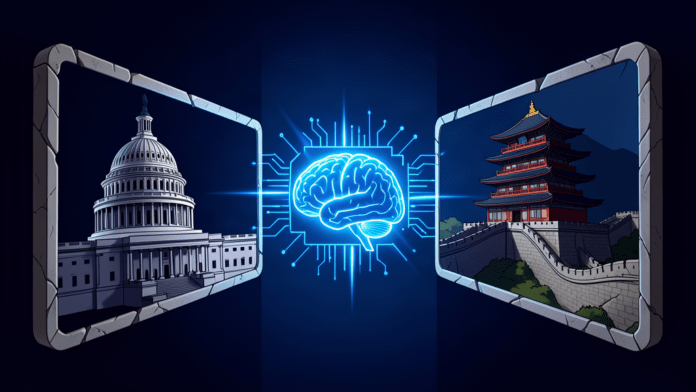

The most powerful voices in artificial intelligence asked for a pause this week. The two governments that matter most said no.
Anthropic chief executive Dario Amodei made a weekend call, backed by OpenAI’s Sam Altman and Elon Musk, for a slowdown in frontier AI development. The response from Washington and Beijing was swift, blunt and, in an odd way, aligned: neither capital has any interest in slowing down.
On Truth Social, President Donald Trump accused Amodei of pretending to be a “perfect little angel” and argued that a “High IQ” president is the only guardrail the technology needs. He went further, declaring that “AI taking over the World, destroying Humanity, and all other things bad, is a HOAX”, comparing the concern to climate change warnings he has long dismissed.
Beijing’s pushback was more restrained but just as firm. The state-run Global Times called the essay’s proposal to keep China off the most advanced AI chips a “Cold War playbook” for AI, and the Foreign Ministry said that “engaging in confrontation and malicious competition” on AI is “not in the interests of any party.”
So the two superpowers, which spent the past year building rival AI ecosystems, now share one piece of common ground: the belief that frontier AI should be allowed to accelerate.
What the leaders are actually saying
Strip away the rhetoric and three positions emerge.
First, the White House sees safety regulation as unnecessary. The president’s argument is that capable leadership, not rules, is the real safeguard. That view puts the United States firmly against any formal restraint on frontier model development.
Second, Beijing reads the slowdown proposal as a technology containment strategy. The call to restrict advanced chips to certain nations is, in its view, an attempt to lock in American dominance. Framed that way, the Global Times response writes itself: any pause that freezes China out of leading-edge computing is a Cold War playbook, regardless of the safety language around it.
Third, the frontier labs are now caught between the two. Their executives signed open letters and made public calls for regulation, partly because they genuinely worry about catastrophic risk and partly because coordinated rules would lock in their own market positions. What they did not anticipate was both governments calling their bluff at once.
Why it matters
The interesting question is not whether the slowdown happens. It will not. The question is what happens to the safety debate when the industry’s own leaders are overruled.
Amodei, Altman and Musk have significant influence inside their own companies. Regulation has historically come from outside pressure, from governments, courts and public opinion. When the external pressure evaporates, internal safety teams lose their strongest argument: that restraint is inevitable, so it is better to design for it.
There is also a geopolitical edge to this. The Trump-Xi meeting was shaping up as the obvious venue for a coordinated pause conversation. With both sides now treating the idea as a scare campaign, that conversation is off the table. The realistic path forward is continued acceleration, with each nation racing to prove its own model of AI leadership.
The practical takeaway
For organisations deploying AI, the signal is clear: expect faster capability growth, not slower. If governments are unwilling to pause frontier development, then the burden of safety shifts to the organisations doing the deploying. That means independent evaluation before adoption, clear acceptable-use policies, and monitoring for drift in model behaviour.
The slowdown debate is not over. It has simply moved from the policy arena to the engineering floor, where the decisions are quieter but the consequences arrive just as fast.
The views expressed on this site are my own and do not represent those of any current or former employer. Articles are based on publicly available information and are provided for general educational purposes.
