


You can measure a company’s ambitions by what it builds for itself. OpenAI just made its ambitions very clear.
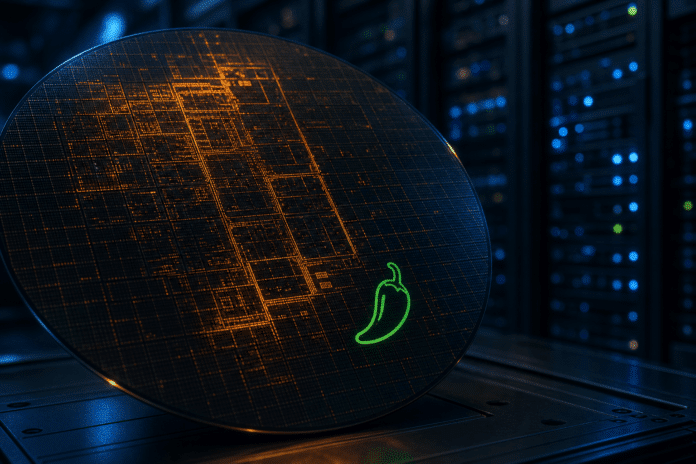
The company revealed details of Jalapeño, its first custom AI chip co-built with Broadcom. Nine months from design to factory-ready – a timeline that typically takes 18 to 36 months for a chip of this complexity. However, here is the detail that made me stop: OpenAI used its own AI models to help design the chip.
That is worth pausing on. An AI company used its own AI to design the chip that will run its AI. The feedback loop is tightening fast.
What Jalapeño actually is
Jalapeño is an ASIC (application-specific integrated circuit) designed for inference – the part of AI where a trained model actually runs and responds to users. It is not a training chip. The distinction matters because inference is where the volume is: every ChatGPT query, every Codex suggestion, every agent action runs through inference silicon.
OpenAI claims Jalapeño delivers “performance per watt substantially better than current state-of-the-art” in testing. If that holds up at scale, it changes the economics of running ChatGPT and future agent systems.
The broader play
This is not just about cost. OpenAI has been almost entirely dependent on Nvidia for the chips powering its models. Building your own inference silicon gives you three things Nvidia cannot provide:
- Cost control at scale. Margin on Nvidia chips is Nvidia’s margin. Build your own and you capture that value.
- Supply chain independence. Every AI company with a serious future is building its own silicon. Google has TPU. Amazon has Trainium and Inferentia. Microsoft has Maia. OpenAI now has Jalapeño.
- Design optimisation. A general-purpose chip has to do everything reasonably well. A custom chip built for your specific models can do one thing nearly perfectly.
The nine-month question
The nine-month timeline is the detail I keep coming back to. ASIC development cycles are famously slow – a year and a half is considered fast. OpenAI says it used its own models to help design and optimise Jalapeño. If that approach generalises, it has interesting implications:
- Each generation of AI chip can be designed faster because the AI itself gets better at chip design
- The gap between announcing a custom chip and having it in production narrows
- Smaller AI companies without chip design teams face a growing moat
OpenAI followed the same playbook as Google, Amazon and Microsoft. The question is whether they can execute faster now that they are in the game.