


The $155 Billion Question: Are AI Data Centres Australia’s Next Mining Boom or a Ticking Timebomb?
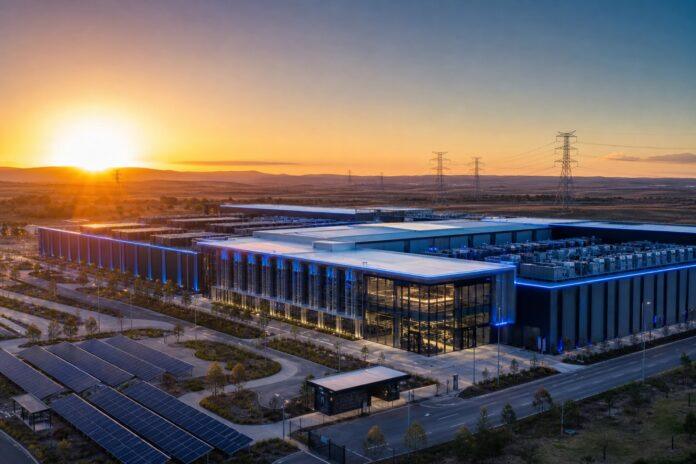
There is a proposal before the New South Wales government to build a hyperscale data centre on Mamre Road in Sydney’s outer western suburbs. If approved, it will stretch across 52 hectares, with six four-storey buildings reaching 40 metres high, 936 cooling units and 852 diesel backup generators. It will be one of the biggest in the world.
This is a single project among many. Australia is in the middle of a sudden, enormous data centre boom driven by the global artificial intelligence revolution. The investment pipeline is estimated at $155 billion over the coming decade, according to Westpac economists. That is 5.6 per cent of one year’s GDP. The boom is so large that economists are comparing it to the mining boom of the early 2000s.
What is Being Built?
There are approximately 160 data centres operating in Australia today, with another 90 proposed according to the Climate Council. The Data Centre Map puts the number even higher at 286 active or planned centres. The major projects include:
- Mamre Road, Western Sydney: A 52-hectare hyperscale facility with six buildings, 936 cooling units and 852 diesel generators. Would be among the largest in the world.
- NextDC M3, West Footscray, Melbourne: Already branded “Australia’s largest hyperscale AI factory”, drawing 225MW of power. It is doubling in size again by the end of 2027, covering 10 hectares less than 10km from the Melbourne CBD.
- Project Mars, NSW: A 90MW data centre being considered by the NSW government, the fourth major centre in its area.
- Global AI leaders: Anthropic is looking at Australia as a potential AI training ground. OpenAI has established a presence in NSW. Microsoft has committed $25 billion in Australian investment.
The Case For: Jobs, Growth and Productivity
The economic case is substantial. Westpac estimates the net GDP boost at around $75 billion, or 2.8 per cent of GDP, after accounting for import leakages. The construction phase alone would temporarily support around 400,000 jobs.
The Australian Financial Review reports that business investment growth hit 6.5 per cent in the March quarter, a rate not seen since the mining boom. The data centre investment is so large it is creating macroeconomic effects on its own.
Proponents argue that Australia must ride the data boom or be left behind. The federal government’s National AI Plan, published alongside the Expectations of Data Centres and AI Infrastructure Developers document in March 2026, makes the case that digital infrastructure underpins essential services, enables cutting-edge scientific research and strengthens national technological capability.
The spillover benefits are significant too. Westpac estimates a roughly 60:40 ratio of indirect to direct economic effects. Local businesses, construction firms and service providers benefit more than the data centre operators themselves.
The Case Against: Energy, Water and Community
The environmental costs are staggering. The Climate Council warns that data centre energy demand will triple by 2030. If this demand is not met with an equivalent increase in additional renewable energy, Australia faces a critical setback in its climate targets. The water demand for cooling is also expected to triple, placing pressure on already constrained water resources as climate change intensifies drought.
In West Footscray, residents like Sean Brown are living in the shadow of the NextDC M3 centre. He takes his 19-month-old son past the facility and describes the construction noise, the looming towers, the insistent background hum and the exhaust from diesel generators. “They are building something which is, frankly, terrible for the community,” he says. “There is no upside to it.”
The United Nations University has published research arguing that AI’s environmental cost is being mismeasured. Greenpeace has released a report on the environmental impacts of AI. The Climate Council published “Clouded Future: Managing the Risks of the Data Centre Boom.”
Economist Nicki Hutley, writing in the Guardian, put it bluntly: “The economic, environmental and social consequences of this data centre investment boom are profound. Yet governments here and around the world are, by and large, taking a laissez-faire approach, perhaps from Fomo on the alleged benefits or from fear of upsetting the billionaire tech bros, or both.”
The Jobs Argument: Actually, Not That Many
One of the most uncomfortable truths about the data centre boom is that the operational jobs are minimal. Industry estimates suggest only two to five operational jobs per megawatt of capacity. The 400,000 jobs Westpac cites are temporary construction roles, not lasting employment.
As Hutley notes, data centres are not hard infrastructure like roads or power, nor soft infrastructure like healthcare. “It is unclear who is benefiting from all this investment, aside from the tech bros, or how.”
The Government’s Position
The federal government has published its Expectations of Data Centres and AI Infrastructure Developers, which introduces the concept of a social licence to operate. But critics say regulation is lagging far behind the pace of development. The UK Labour government now requires data centres to contribute to net-zero energy targets to receive approval. Australia has no equivalent requirement.
“There are huge opportunities but we need to be smart. There is some level of data centre investment that is good for Australia. The question is: how much?”
Alex Hooper, Head of Climate and Energy Economics, Oxford Economics Australia
What the Future Holds
The global picture is staggering. McKinsey estimates the worldwide cost of data centre expansion at $7 trillion, representing 5 per cent of global annual GDP. The number of data centres globally is expected to increase by 3.5 times.
For Australia, the path forward requires answering three questions. First, how much data centre investment is the right amount? Second, how do we ensure the benefits are shared broadly rather than captured by a handful of global tech companies? And third, how do we build the infrastructure without destroying the environmental conditions that make Australia worth living in?
As the Mamre Road proposal works its way through the NSW planning system, and as the NextDC centre in West Footscray grows larger, these questions are moving from academic to urgent. The data centre boom is arriving whether we are ready or not. The question is whether we will manage it, or it will manage us.
What You Can Do
If you live near a proposed data centre, engage with the planning process. Write to your local MP. Ask your state government what environmental assessment is being done. Ask what renewable energy requirements are in place. Ask what happens when the diesel generators run.
The decisions being made now will shape Australia’s energy system, water resources and communities for decades to come. They deserve scrutiny, debate and most of all, a clear-eyed assessment of whether the benefits truly outweigh the costs.
This article was researched and published with the assistance of AI tools. All sources are linked and verifiable. Key sources: Nicki Hutley’s op-ed “Datacentres are a ticking timebomb” (The Guardian, 9 July 2026); “Thirsty and power hungry” (The Guardian, 22 June 2026); “Under a cloud” (The Guardian, 3 May 2026); Westpac IQ “Powering the AI Economy” (May 2026); “Data centre investment rivals mining boom” (AFR, June 2026); Climate Council “Clouded Future” report; Industry Department “Expectations of Data Centres” (March 2026).
Related Reading
- Microsoft, Amazon and OpenAI Are Spending $155 Billion on Australian Data Centres. Is That Good for Us?
- SpaceX and Nvidia Team Up for Orbital AI Data Centres
- Shadow AI Just Made Your Next Data Breach $670,000 More Expensive
The views expressed on this site are my own and do not represent those of any current or former employer. Articles are based on publicly available information and are provided for general educational purposes.
