

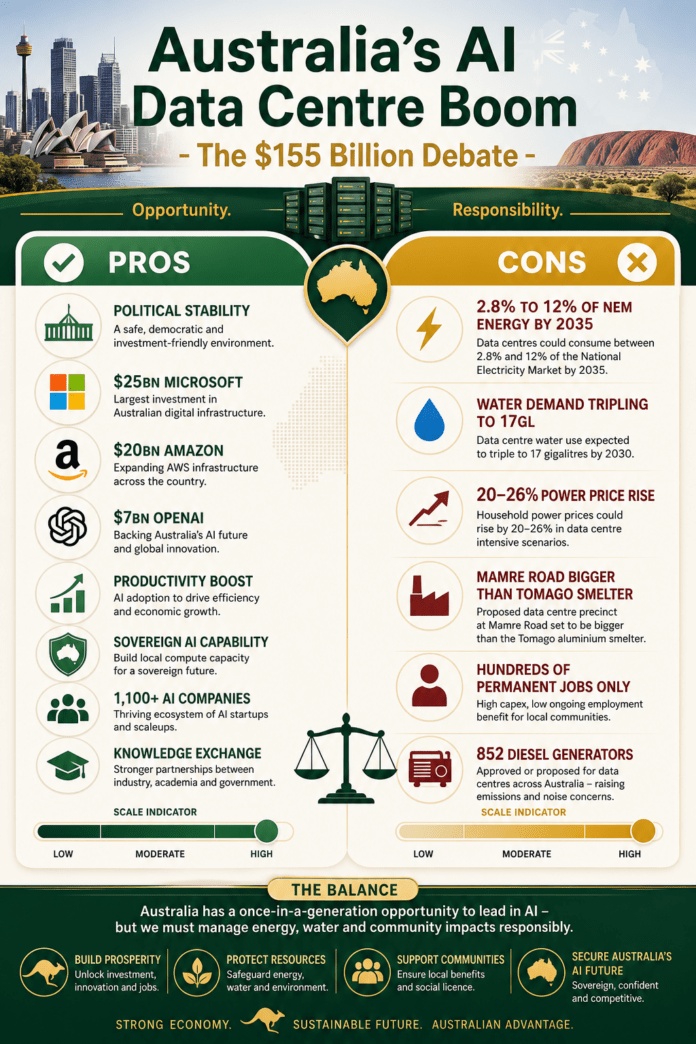

Here is a number that stopped me: $155 billion. That is the estimated investment pipeline for data centres in Australia over the next decade. Microsoft alone has committed $25 billion, its largest ever investment in the country. Amazon is spending $20 billion by 2029. OpenAI has partnered with NextDC on a $7 billion AI campus in Western Sydney.
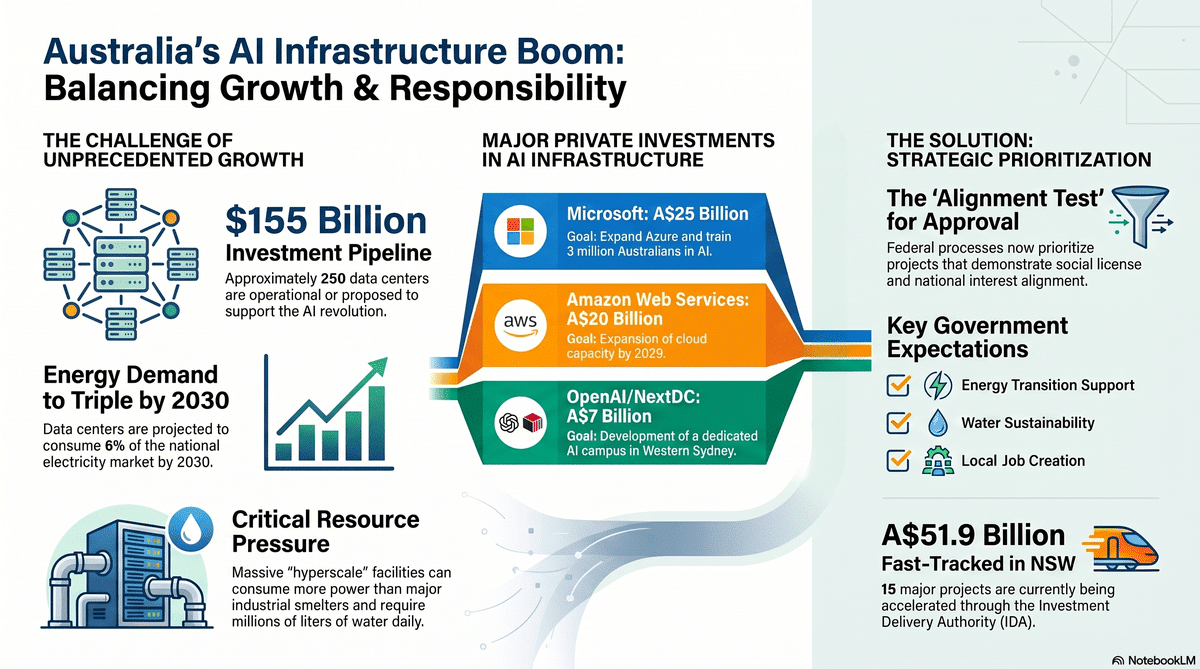
These are not small numbers. This is the biggest industrial build-out Australia has seen since… well, maybe ever. However, it raises a question that no one seems able to answer cleanly: is this good for us?
Let me lay out both sides of the argument, because the answer matters for every Australian who pays an electricity bill, uses water, or cares about where the economy is heading.
Why Australia? Four reasons the money is flowing in
Australia did not wake up one day and find itself a data centre destination by accident. The country checks every box the hyperscalers are looking for.
Political stability and rule of law. In a world where tech companies are increasingly worried about export controls, sudden regulatory shifts, and geopolitical risk, Australia offers something rare: predictability. The government has positioned itself as rigorously regulated but tech-friendly, and the Commonwealth Expectations framework launched in April 2026 gives investors a clear approvals pathway.
Proximity to Asia. Australia sits next to the fastest growing digital markets on earth, connected by 17 submarine cables with more under construction. Our time zones overlap with key Asian markets. We can offer backup data storage and processing for customers across the region.
Renewable energy potential. The big tech companies are the largest corporate buyers of renewable energy globally. Australia has abundant solar and wind capacity, and lower industrial energy prices than competing hubs like Singapore. The marketing pitch writes itself: build green data centres in Australia and power them with our renewable resources.
Land and distance from conflict zones. Large tracts of available land near urban centres, combined with geographic distance from active conflict zones, makes Australia a safe bet for infrastructure that needs to run uninterrupted for decades.
The case for: this is the foundation of the next economy
Pat Bustamante, a senior economist at Westpac, put it plainly to the Guardian: “There’s absolutely no question that the data centre boom is good for the economy. It’s laying the foundation for the next wave of productivity growth. We saw this during the PC and IT revolution during the late 90s, and this is going to be bigger than that.”
The argument is straightforward. Data centres are the factories of the 21st century. They enable the AI capability that will drive productivity gains across every sector. Hosting that capacity onshore builds sovereign digital infrastructure, which the National AI Plan explicitly identifies as a strategic priority. Australia already has more than 1,100 private AI companies. This investment gives them the infrastructure to scale.
Beth Webster, an economics professor at Melbourne University, adds that foreign direct investment brings knowledge exchange: “I can’t see too many downsides as long as they have rules around it.”
NAB’s chief economist Sally Auld acknowledges the public anxiety about AI but says her research suggests the technology will augment rather than replace most jobs.
The case against: power prices, water and the jobs math
This is where the numbers get uncomfortable.
Energy. Data centres currently account for 2.8 per cent of electricity consumption on Australia’s east coast. The Australian Energy Market Operator projects that will triple to 7 per cent by 2030 and exceed 10 per cent by the mid-2030s. The proposed Mamre Road hyperscale data centre in Sydney’s west would alone consume 1.2 gigawatts of power, making it Australia’s single largest energy user, surpassing the Tomago aluminium smelter.
The Climate Council estimates that if this demand is not matched by new renewable generation, wholesale electricity prices could rise by 20 per cent across the national grid by 2035, and up to 26 per cent in NSW. Since wholesale prices make up about 40 per cent of a typical residential power bill, that hits households directly.
Water. Data centres use enormous amounts of water for evaporative cooling. Industry estimates suggest total water demand will more than triple from 5.5 gigalitres to 17 gigalitres over the next five years. Sydney Water is receiving applications for single data centres to use up to 40 million litres per day, equivalent to 16 Olympic swimming pools.
Jobs. This is the one that frustrates me most. These projects create thousands of construction jobs, but once operational, they employ only hundreds of people. For the scale of investment and resource consumption, the permanent employment return is surprisingly thin. US studies consistently show the same pattern: thousands of workers during the build, a fraction of that to run the facility.
Community opposition. The Mamre Road project faces active opposition from Penrith council, which does not want six four-storey buildings with 852 diesel backup generators in its backyard. This tension is playing out across multiple suburbs.
The framework that is supposed to manage this
In April 2026, the federal government introduced the Commonwealth Expectations, a set of five criteria that data centre projects must align with to be prioritised for approval: national interest, energy transition support, sustainable water use, investment in Australian skills and jobs, and strengthening research and innovation.
The industry reaction has been positive. The framework provides clarity. Fifteen major projects representing $51.9 billion in potential investment are already progressing through the NSW Investment Delivery Authority with fast-track pathways.
But the Climate Council argues the framework does not go far enough. It is a set of expectations, not enforceable standards. The Council wants mandatory requirements: data centres should have to build additional renewable capacity to match their demand, pay for the energy and water infrastructure they require, and report transparently on their consumption.
Alex Hooper from Oxford Economics Australia put it well: “There are huge opportunities but we need to be smart. There is some level of data centre investment that is good for Australia. The question is: how much?”
What I think
The AI data centre boom is coming whether we plan for it or not. The capital is already committed. The construction is already underway. The question is not whether to accept the investment. It is whether we have the regulatory backbone to make sure the benefits flow to Australians and the costs do not land on household electricity bills.
The Commonwealth Expectations are a start. But expectations are not requirements. Until data centre operators are required to build the renewable capacity they will consume, and pay for the water infrastructure they demand, the risk is that ordinary Australians end up subsidising the AI infrastructure of the world’s most profitable companies.
That is not a trade-off I am comfortable with.
Australia is about to build the equivalent of another Tomago aluminium smelter for every major city. The question is whether we own the power it produces or just the bill for it.
Related Reading
- AI Agents, Copilot and the New Security Risk: When Helpful Becomes Dangerous
- Your AI Agent Is Not a Chatbot: The Hermes Security Guide You Actually Need
- Three AI Models, Three Different Futures: Fable, Fugu and GLM 5.2 Compared
The views expressed on this site are my own and do not represent those of any current or former employer. Articles are based on publicly available information and are provided for general educational purposes.
