


Every few weeks a new AI model lands with bigger numbers attached. More parameters, longer context, higher benchmark scores. The launch from TypeSafe this week is different, because the company is not trying to play that game at all. Its founder, Diogo Almeida, helped build the research behind ChatGPT while at OpenAI. His new system, Jev, cannot generate text on its own. By design.
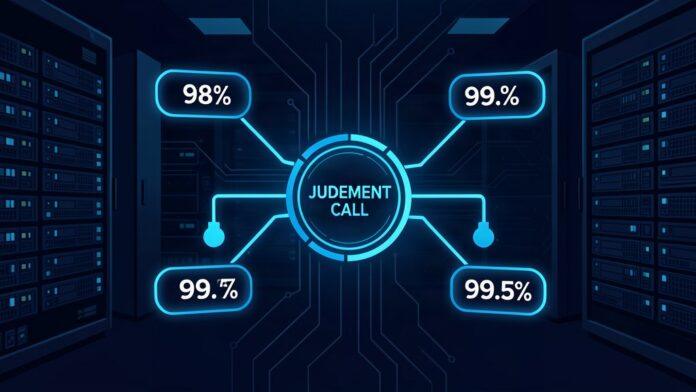
Jev is what TypeSafe calls a “frontier-intelligence function call.” Instead of predicting the next word, it answers preset questions inside software by choosing between options set in advance, and it attaches a confidence score to every answer. Think of it as a decision engine for the boring, repetitive judgment calls that run underneath your applications: sorting requests, scoring records, screening another AI’s output for jailbreaks.
The claims: fast, cheap, and incapable of hallucinating
The headline numbers from TypeSafe are striking. Jev runs at $42 for a billion input tokens, with output free, a price the company estimates at 238 times below Claude Fable 5.1’s rate. Responses come back in 70 to 500 milliseconds, somewhere between 40 and 200 times faster than today’s large language models.
Because Jev can only choose between answers that were defined in advance, TypeSafe says it “can’t hallucinate.” There is no room for the model to invent a fact, because there is no open-ended generation happening. That is a meaningful design difference, not marketing spin. Hallucination is a property of generative systems, and Jev is deliberately not one.
More like a database than a coworker
Almeida is careful about what Jev is not. It is not a system to stack up against large language models, and he has described it as “more like a database than a coworker.” The distinction matters for anyone planning an AI strategy. A database answers known questions reliably and cheaply. A coworker handles open-ended problems you cannot fully predict. Jev sits firmly in the first camp.
That positioning is where the Jevons paradox comes in. The economic idea holds that when something becomes cheaper, people use more of it, and total consumption rises even as unit cost falls. If Jev really is this fast and this cheap while staying reliable, the same logic applies: small decision tasks that were never worth sending to a large model suddenly become worth automating. The result is likely to be more AI calls inside software, not fewer.
What it means for your stack
For Australian businesses building on AI, the practical question is not whether Jev beats ChatGPT on a benchmark. It is whether a cheap, fast, deterministic layer belongs inside your own applications. Screening AI-generated content before it reaches customers, scoring inbound requests, and routing work based on preset rules are all tasks where confidence scores beat open-ended chat.
There are caveats. TypeSafe has emerged from stealth with a big story, and production reliability is yet to be proven at scale. Preset options also mean Jev is only as good as the choices humans define for it. If your decision space is not well understood, a fixed-choice engine will not save you. But for the high-volume judgment calls where today’s models are overkill, this is the first serious argument that a different architecture might be the right tool.
The lesson for security and technology leaders is to stop treating every AI decision as a language model problem. Some tasks need a coworker. Increasingly, many more need a database with a confidence score.
When an AI system is fast, cheap, and honest about what it can do, the boring judgment calls become the ones worth automating first.
Related reading: OpenAI Claims a $1M Millennium Prize With a Secret Model and Inside OpenAI’s Push to Self-Improving AI.
