

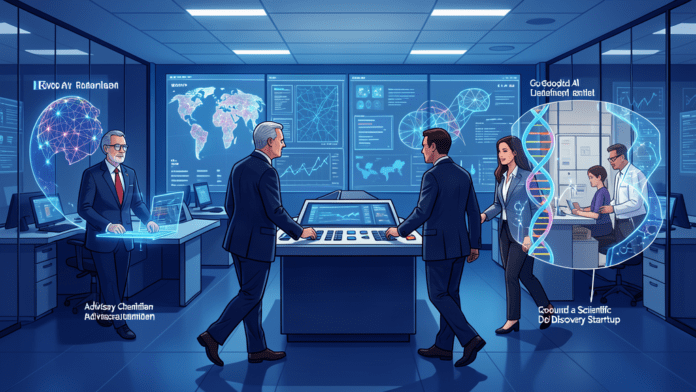

Google has announced a significant leadership reshuffle across its AI divisions, marking one of the most consequential reorganisations in the company’s recent history. DeepMind CEO Demis Hassabis will transition to the role of chairman, while long-serving chief scientist Jeff Dean departs to co-found a new scientific discovery startup. The changes come at a pivotal moment for the tech giant, as it faces intensifying competition in the AI race and growing scrutiny over delayed product releases.
Under the new structure, Koray Kavukcuoglu, DeepMind’s current chief technology officer, will assume day-to-day leadership of the company’s frontier model work. He takes the reins as senior vice president, with direct responsibility for advancing Gemini 4 and Google’s next generation of artificial intelligence systems. Meanwhile, Hassabis will refocus on what Google describes as “strategic and global AGI matters.” He will continue advising DeepMind while also leading Isomorphic Labs’ drug discovery initiatives, signalling that Google intends to keep his expertise available even as his operational role changes.
Dean’s departure closes a remarkable 27-year chapter at Google. Together with three other former Google veterans, he is launching Discovery Loop, a public benefit company designed to automate scientific research. The venture aims to accelerate breakthroughs by applying advanced computational methods to problems in biology, chemistry, and materials science. Sanjay Ghemawat, Oriol Vinyals, and Quoc Le have joined Dean in the effort, creating a formidable team with deep roots in Google’s most successful technical infrastructure projects.
The leadership changes arrive amid mounting pressure on Google’s AI division. The company’s Gemini 3.5 Pro model has experienced notable delays, and several top researchers have accepted senior roles at competing organisations that continue to release frontier AI systems at a rapid pace. Sundar Pichai, Google’s chief executive, has framed the reshuffle as essential to maintaining the company’s competitive edge. He told investors that the shift reflects Google’s commitment to staying at the frontier while shaping the future of artificial general intelligence.
Investors reacted cautiously. Google’s share price slid approximately four percent following the announcement, a move that analysts attributed to concerns about instability inside the research laboratory during a critical phase of the AI race. The market reaction suggests that investors view the departure of Hassabis and Dean as more than a routine leadership adjustment; they see it as a signal that Google may be struggling to execute on its AI ambitions at the same pace as rivals.
Google’s rivals have not paused. OpenAI, Anthropic, and several well-funded startups continue to release models and features that capture developer attention and enterprise contracts. Meta, for instance, has recently entered the coding agent market with Muse Code, while Microsoft DeepMind’s former competitors at xAI have advanced their own flagship models. The environment makes Google’s internal transition riskier, because any execution gap between now and when Kavukcuoglu stabilises operations could hand additional market share to competitors.
The broader implications extend beyond Google’s balance sheet. Hassabis and Dean were not merely managers; they were the principal architects of Google’s AI strategy for more than a decade. Their institutional knowledge and scientific credibility helped attract talent, direct billions of dollars in investment, and establish Google as a dominant force in machine learning research. Their simultaneous departure tests whether Google’s bench strength is deep enough to sustain its leadership position without them.
For the AI industry, the reshuffle serves as a reminder that the race for artificial general intelligence remains wide open. Google’s ability to preserve its research edge while closing execution gaps will determine whether it can maintain its position at the frontier. Kavukcuoglu now faces the difficult task of continuing Gemini’s development, retaining key researchers, and restoring investor confidence all at once. The next twelve months will reveal whether this leadership reshuffle stabilises Google’s AI ambitions or accelerates the competitive momentum of its rivals.
Related Reading
- The NSA Just Issued Its First Formal Warning About AI Agent Technology. Your IT Team Needs to Read It.
- SpaceX and Nvidia Team Up for Orbital AI Data Centres
- AI Agents Are Everywhere. Your Security Team Probably Isn’t Ready.
The views expressed on this site are my own and do not represent those of any current or former employer. Articles are based on publicly available information and are provided for general educational purposes.
