

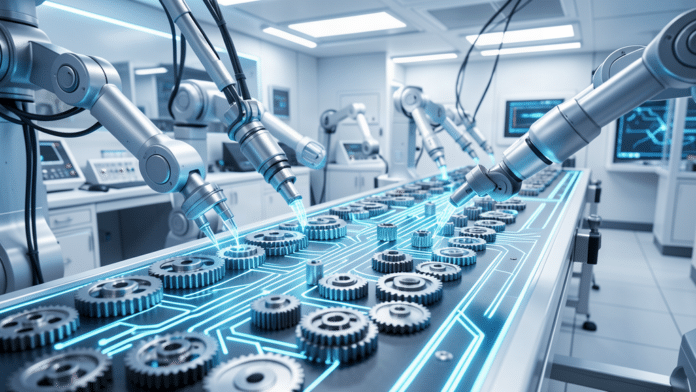

Atomic Machines, the deep-tech startup founded by former Uber self-driving chief Jeff Holden, has emerged from six years in stealth with a bold promise: an AI-guided factory that can turn digital designs into working physical devices.
The California-based company has raised $250 million to commercialise its “Matter Compiler” technology, which it says goes far beyond what 3D printing can achieve.
What Is a Matter Compiler?
Holden draws a clear line between his approach and conventional additive manufacturing. A 3D printer alters an object’s shape, he explains. His Matter Compiler builds a whole new device when the code changes, without needing retooling or manual reconfiguration.
Each production step is verified before a part moves to the next stage. The process feeds the AI new data on which materials actually work in practise, creating a closed-loop learning system that improves with every build.
Microscopic Machines for Real Problems
Atomic Machines focuses on gadgets with moving parts too small to see without a microscope – tiny pumps, motors and gears that even advanced chip factories cannot produce. The first commercial product is PrimeSwitch, a fingertip-sized power switch designed for AI server farms. The company claims it is faster than traditional circuit breakers and more efficient than silicon-based alternatives.
From Vibe Coding to Prompt-to-Product
The broader vision aligns with a trend playing out across the tech industry. Vibe coding lets people describe an app in natural language and get working software. Atomic Machines wants to do the same for physical hardware with what it calls “prompt-to-product manufacturing.”
For now, the company is building only its own products with humans still in the loop. But the long-term ambition is that “virtually anyone with a concept” could one day turn it into a real device.
What This Means
The concept is early, and Atomic Machines has spent six years in stealth to get this far. But the implication is hard to ignore. If the Matter Compiler works at scale, it could radically shorten the distance between an idea and a physical product – effectively doing for manufacturing what large language models did for software.
For AI infrastructure specifically, PrimeSwitch addresses a growing bottleneck. AI server farms consume enormous power, and more efficient switching at the component level could meaningfully reduce energy waste across thousands of racks.
